 MyDiveLog
For divers who want to understand what their data is telling them, not just store it. Every dive you have ever made in one archive — even if you have changed computers three times. MyDiveLog merges them without duplicates, analyses them one by one, and holds every field Italian law 70/2026 asks for: ready to show, as a PDF, five minutes after surfacing.
This project was born for
The package above needs macOS 12 and an Apple Silicon Mac, and updates itself. The same app is also on the Mac App Store, if you would rather let Apple keep it up to date.
But it was later released for
FreeNo accountOpen source Windows, Android and Linux: what differs → Will it read my computer? →


We read data from these computers
The merge
You wear one computer and carry a backup. You changed computer a few years ago. You download both from the manufacturer app and from the device. In all three cases the same dive ends up in two different files, and neither of them is complete. A logbook that makes you pick one makes you throw away half of what you have.
Neither entry disappears, and no data is left behind.
The offset is inferred across your whole logbook, and the match is confirmed on the shape of the profile — not on the timestamp.
Between a denser profile and one that knows about decompression, both win — each for what it knows.
Every dive lists the sources it was built from. When a value is missing you know which computer never wrote it.
The law
Since 10 May 2026 Italian law — law 70/2026, article 12(8) — requires every diver to keep a dive logbook with thirteen specific entries. And it says something that changes everything: it may be digital. Not “tolerated in digital form”: it is written in the text.
MyDiveLog keeps all thirteen, the guide's signature included.
With a finger, on the phone you have on the boat. The mark stays attached to that dive, with a name and a date, and reprints crisply on paper: it is stored as strokes, not as a picture.
No field fills itself in, and the depth you planned never becomes the depth you reached. On a document someone signs, an invented value is worse than a missing one.
A logbook matters at the moment someone asks for it. Every dive exports to PDF with the thirteen entries spelled out, from the computer or from the phone: you send it there, on the boat, five minutes after surfacing.
And none of this is mandatory. A dive with friends has no centre and no guide, and that does not make it irregular: no red fields, no warnings, no reminders. The app keeps the data, it does not lecture you.
This is not legal advice and the application does not claim to be “compliant”: it holds the fields the rule lists, and compliance belongs to whoever fills the logbook in. Article 12(8) sits in the article governing dive centres, and whether the duty also binds divers going out on their own is not settled by the text.
Features
Not “keeping a list”: a paper notebook does that, and has done it for fifty years without a battery. This one reads, merges, computes — and tells you what to work on next time.
UDDF, Shearwater, Scubapro LogTRAK, Garmin FIT, Subsurface, CSV. The format is recognised by its contents, not its extension.
The first time it reads the computer’s whole memory. From the second on, only the new dives.
Bühlmann ZH-L16C, oxygen exposure, buoyancy and ascent rate — and under every number, how reliable it is.
Gas and decompression, CCR, bailout and contingencies. Consumption comes from your own dives, not from a manual.
Statistics, trends and coaching — each with the number that justifies it underneath.
One page per dive, with the thirteen fields the law asks for and the profile. From the phone you send it to whoever asks.
Screens
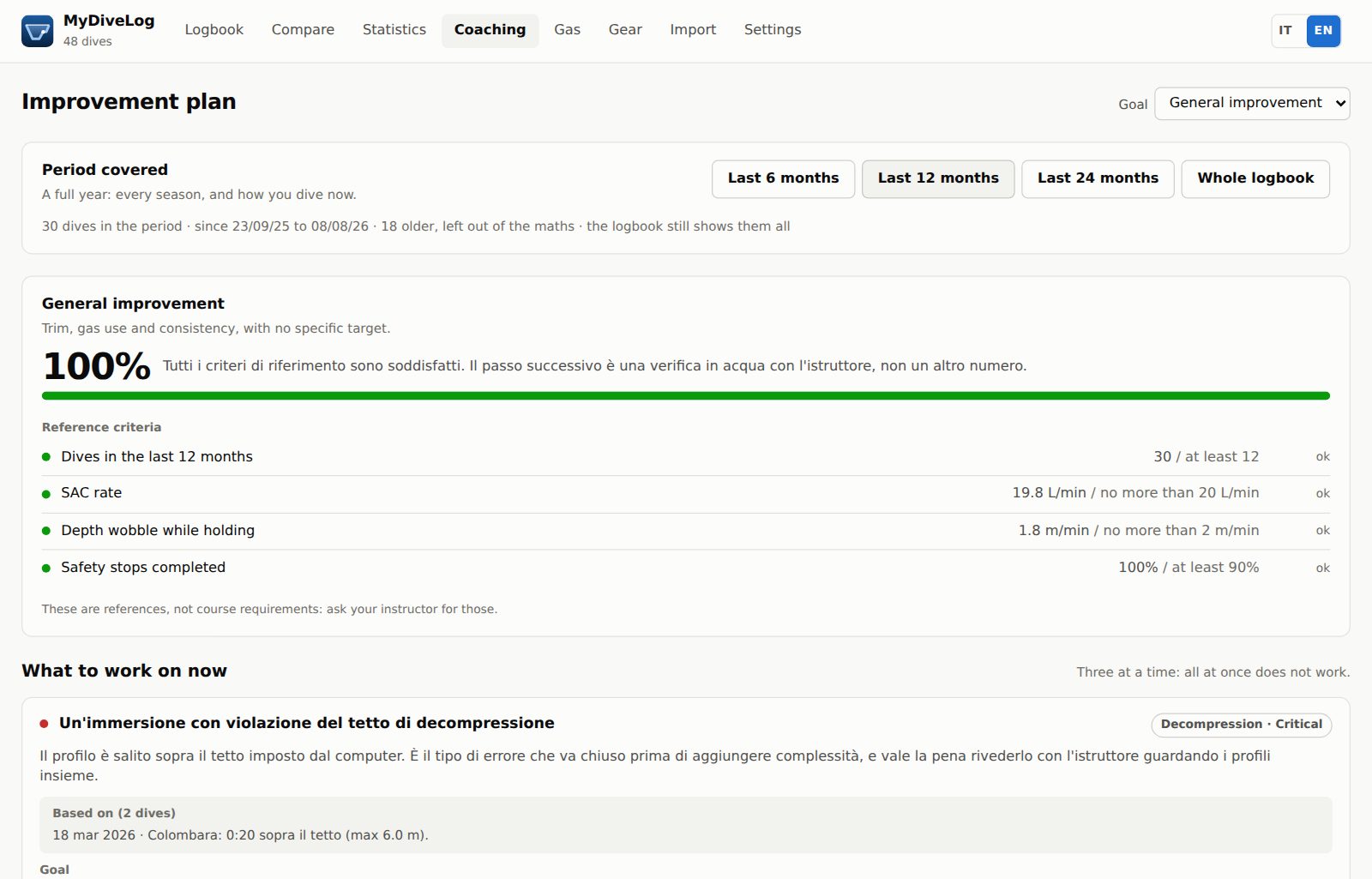
Five screens, five things it does: merge, read a profile, pull out the numbers, plan gas, say what to work on.
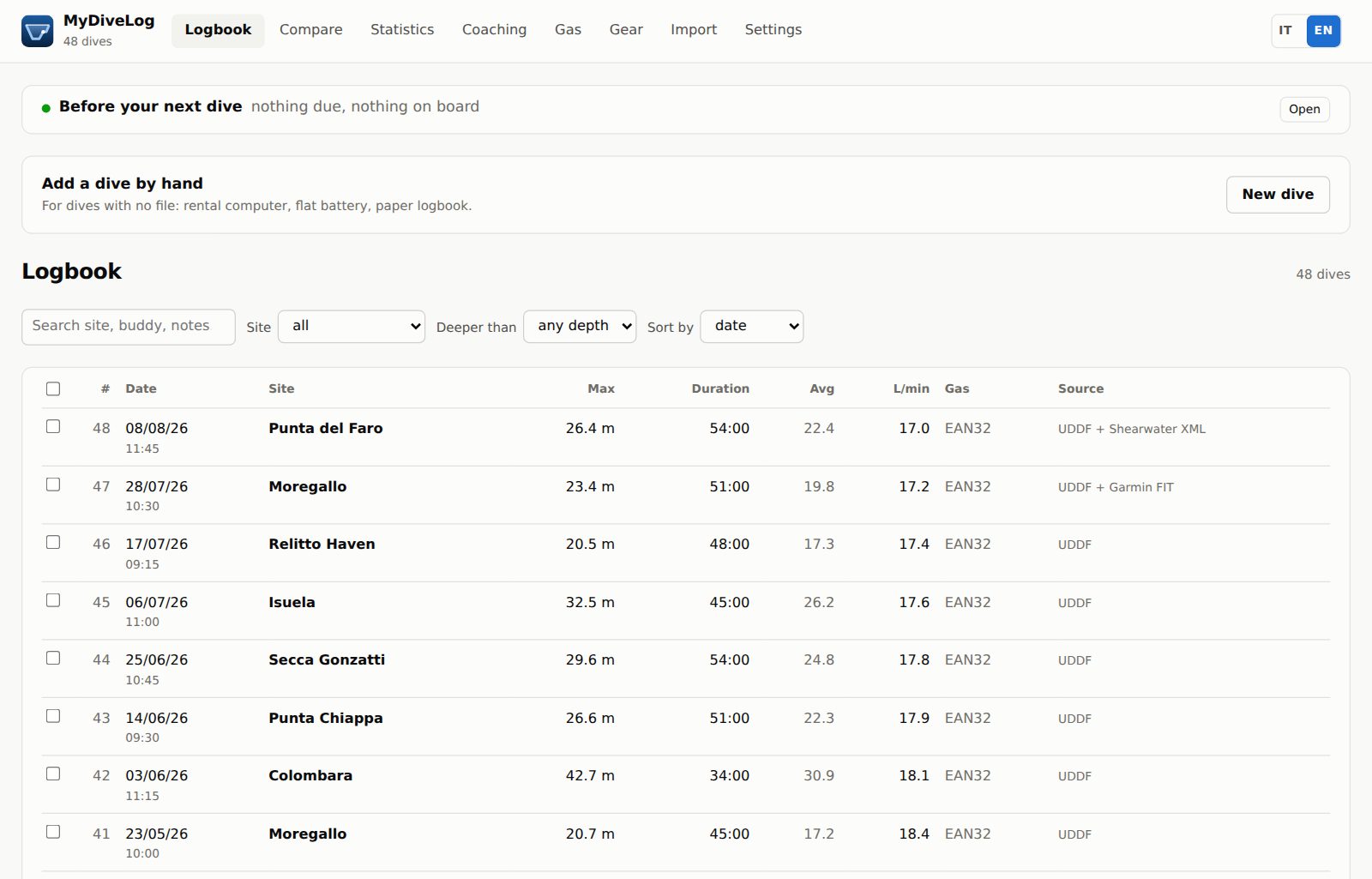
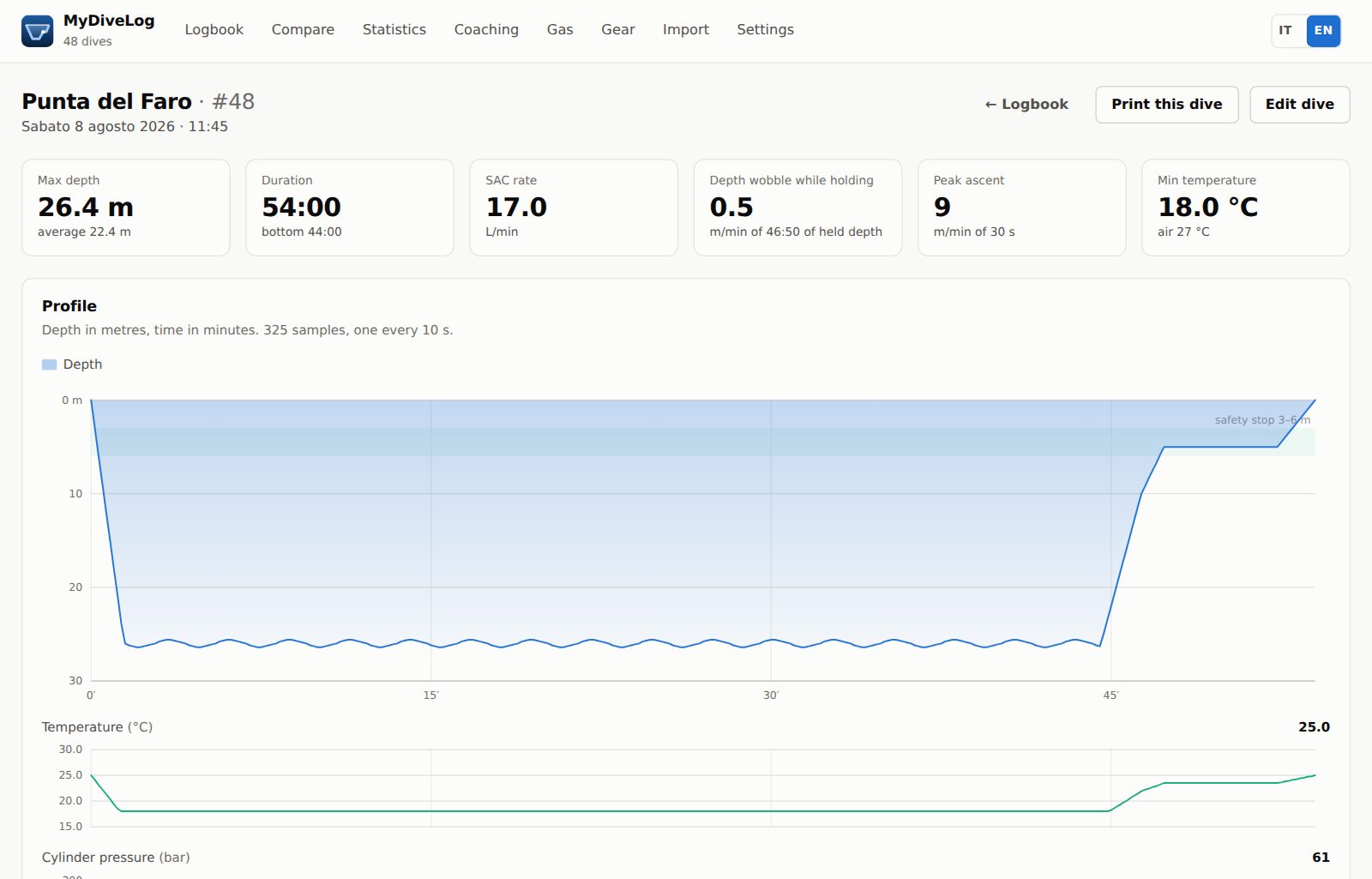
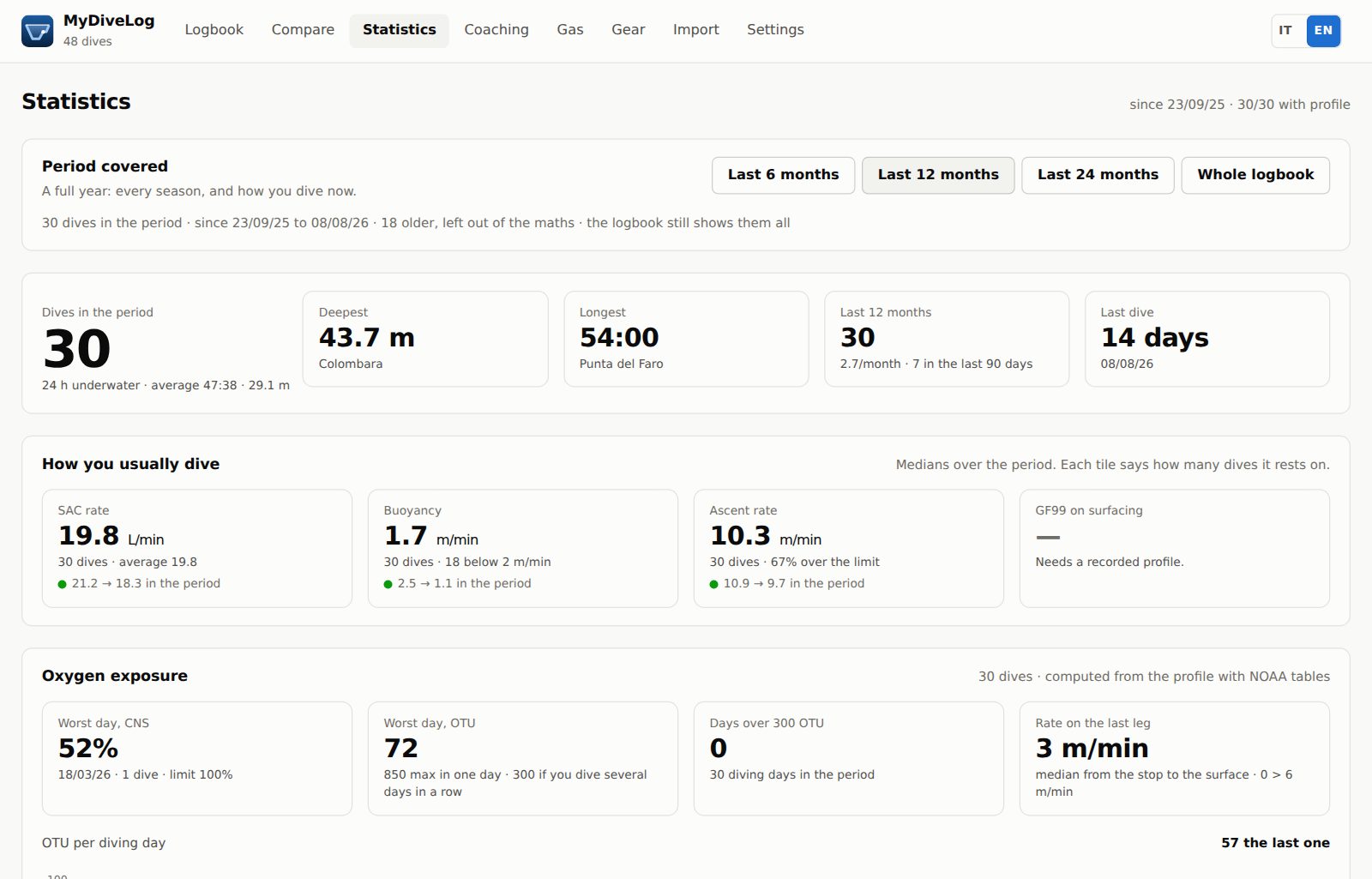
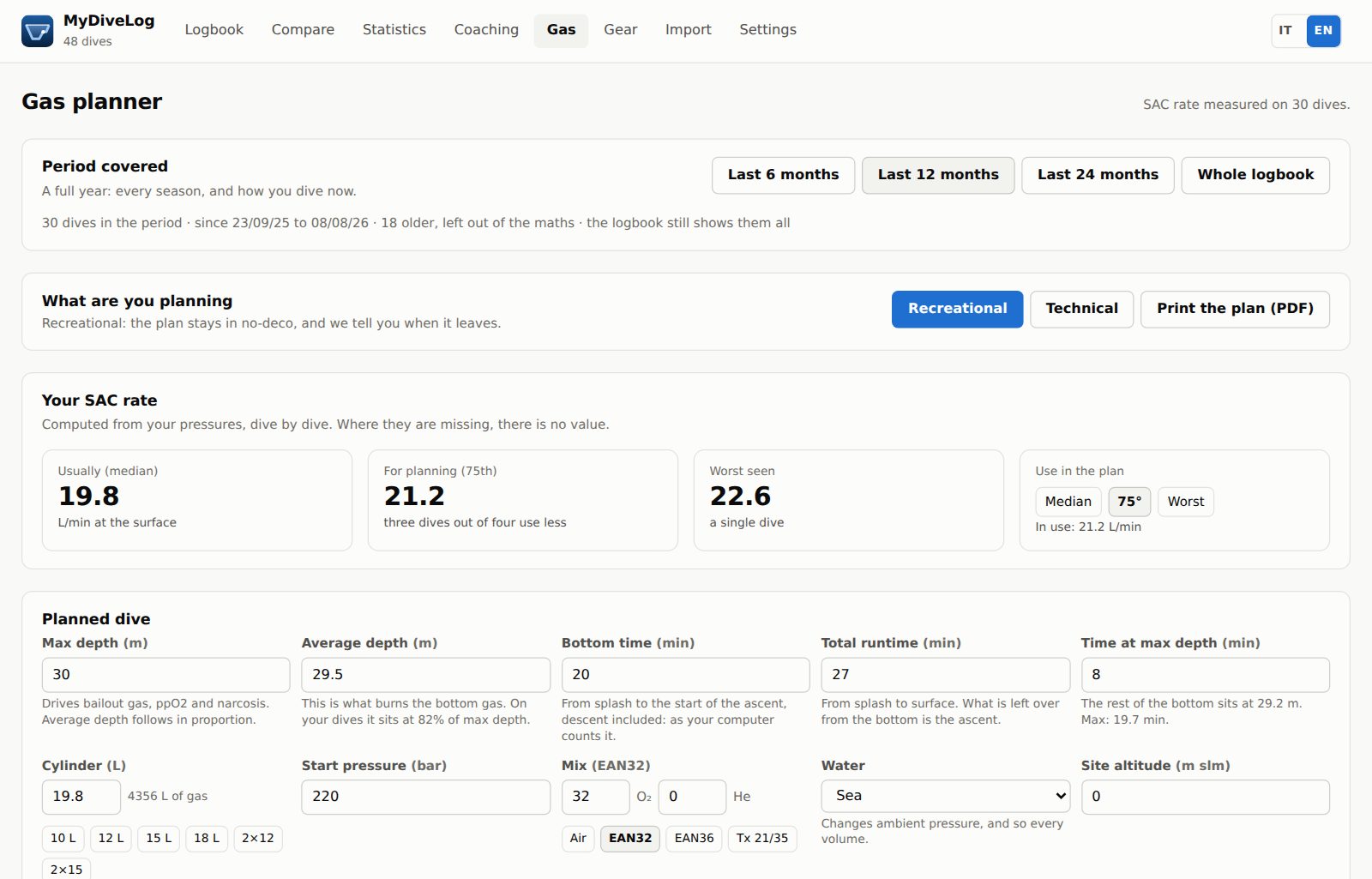
Sync
If you use more than one device, you can keep your logbook aligned. You sign in with an Apple or Google account and the app creates a database that is yours alone: there is nothing to configure, and dives travel directly between the application and that database.
Signing in is optional, and syncing is never automatic. The logbook opens, imports and analyses without ever seeing an account, because the archive is on your device. And nothing leaves until you press Sync: a logbook gets read on a boat, where there is no network.
Every person gets a database physically separate from everyone else's — not a row in a shared table. The service that hands out the keys keeps no list of users and never sees your dives: it says who you are and gives you a key that lasts two hours. You can delete your account from inside the app, and the database with it. See the Privacy details.
The code
Every app asks you to trust it. This one hands you the means to check. MyDiveLog is free software under the MIT licence: the code can be read, copied, modified and rebuilt. By anyone, without asking us.
That is not a programmer's pose. A logbook decides where your data ends up, and a promise written on a website is worth exactly as much as whoever wrote it: the only way to really know what a program does is to read it. It is all on GitHub — the decompression maths, the code that talks to your dive computer, and the lines that decide to send nothing anywhere.
And there is one thing free software gives you that no subscription ever will: if we vanished tomorrow, the program stays. It does not expire, cannot be switched off from a distance, and will not lock you out of your own logbook. Your dives are yours, and they stay readable without us. Look at the code.
// The Schreiner equation: how much gas enters a tissue
// while ambient pressure changes at a constant rate.
const k = Math.LN2 / semiperiodo;
const carico =
  gasIniziale +
  tasso * (tempo - 1 / k) -
  (gasIniziale - inerteIniziale - tasso / k) * Math.exp(-k * tempo);
Other platforms
They do everything the Mac version does. What changes is how they update, and what the system says the first time you open the file.
.exe installer.apk package.deb package, amd64
It re-downloads by hand for two different reasons. On Android, an app that updates itself would have
to ask for a permission scarier than it is worth; on Linux, automatic updates would only work with a
package format other than the .deb, which is what people expect.
None of the three is signed by an authority, so the file cannot vouch for itself. Its SHA-256 fingerprint can, and it is published next to the package on the releases page: if it matches the file you downloaded, it is ours.
Safety
MyDiveLog is not a dive computer and must not be used to make decisions in the water. Its decompression calculations, plans and analyses exist to study the dives you have done and prepare the ones you are going to do: they do not replace your dive computer, your training or your judgement. Scuba diving carries risks, including death.
Free, no account and no subscription. Download it, drop in the files you already have, and a minute later your whole history is in a single list.
MyDiveLog is open source and free. If you like it and want to help keep it alive, you can do it here.
Buy me a coffeeOpens PayPal. No account needed — a card works too.
A bug, a dive computer that will not connect, a number that looks off, or just something missing. Reports are how this project gets better, and this is the shortest way in.